


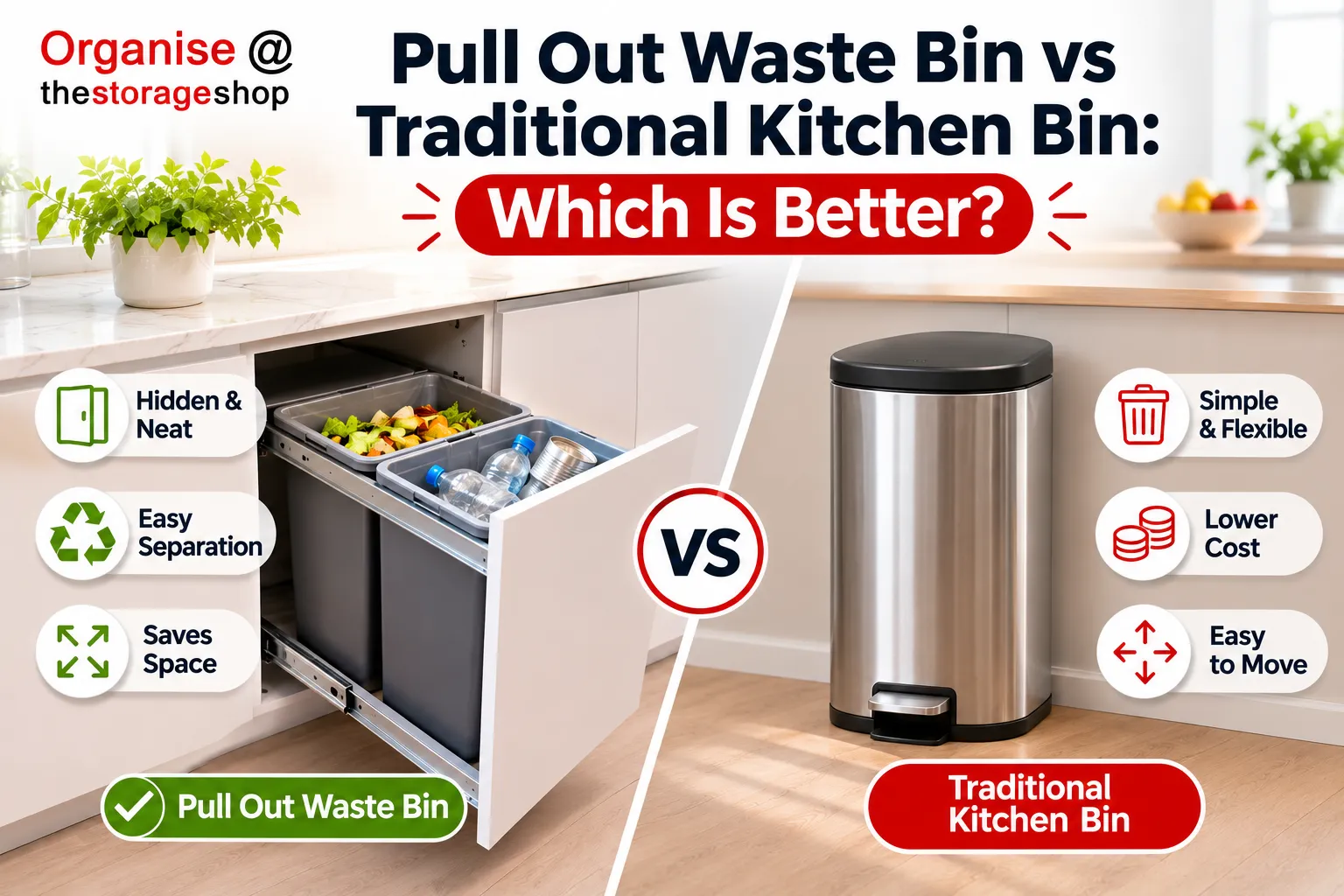
Short answer: A pull out waste bin is the better pick for most owner-occupied kitchens, because it keeps rubbish out of sight, off the floor and sorted into separate buckets. A traditional kitchen bin wins if you rent, want to spend less now, or need something you can move around. Which one suits you depends on your household more than the bins.
Most people choose a kitchen bin in about thirty seconds, in a shop aisle, by picking whichever looks least ugly. Then they live with it for five years. A few minutes thinking about how your household produces rubbish gets a far better result.
The two contenders
A pull out waste bin sits inside a base cabinet. One or more buckets sit in a frame on runners, and you slide them forward when you need them. Close the cupboard and the bin disappears.
A traditional kitchen bin stands on the floor. It comes in a few common styles:
-
Pedal bins: hands-free and cheap. Better models have a removable inner bucket, which makes washing much easier.
-
Swing-lid bins: simple and quick to use, but the lid gets grubby fast.
-
Sensor bins: the lid opens with a wave of your hand. They’re handy when your hands are messy, but they need batteries or charging.
-
Open-top bins: the cheapest option, though they do nothing to contain smells.
Which one suits your household?
You’re renting or moving soon
A traditional bin is the sensible choice. Fitting a pull out frame means screwing into the cabinet, which most leases don’t allow. A good pedal bin with an inner bucket goes with you on moving day.
You live in a small apartment
A pull out waste bin is worth the effort here. A slim double unit of around 30 litres fits a 300 mm cabinet and clears a patch of floor you’d otherwise keep stepping around.
You’re a family sorting recycling and food scraps
This is where pull out systems really win. Many Australian councils now collect general waste, recycling and food organics separately. A double or triple unit in a 450–600 mm cabinet holds all three streams in one place, so you don’t end up with a row of bins along the kitchen wall.
You’re renovating
Plan the bin cabinet into the design from the start. Put it right next to the sink or main prep bench, and avoid the cupboard beside the dishwasher, because an open dishwasher door blocks it. Browse pull out waste bin sizes before your cabinetmaker locks in the cabinet widths.
You’re on a tight budget
Buy a solid freestanding bin now and fit a pull out unit later.
Side by side
|
Pull out waste bin |
Traditional kitchen bin |
|
|
Where it lives |
Inside a base cabinet |
On the floor |
|
On show |
No |
Yes |
|
Waste streams |
1–4 buckets in one unit |
Usually one per bin |
|
Kids and pets |
Hard to reach behind a door |
Easy to tip or raid |
|
Installation |
Needed |
None |
|
Moving house |
Stays with the kitchen |
Comes with you |
|
Upfront cost |
Higher |
Lower |
The kids and pets row gets overlooked. If your dog has ever raided the bin while you were out, a bin behind a cupboard door solves the problem without a lock or a heavy lid.
What about an under sink kitchen bin?
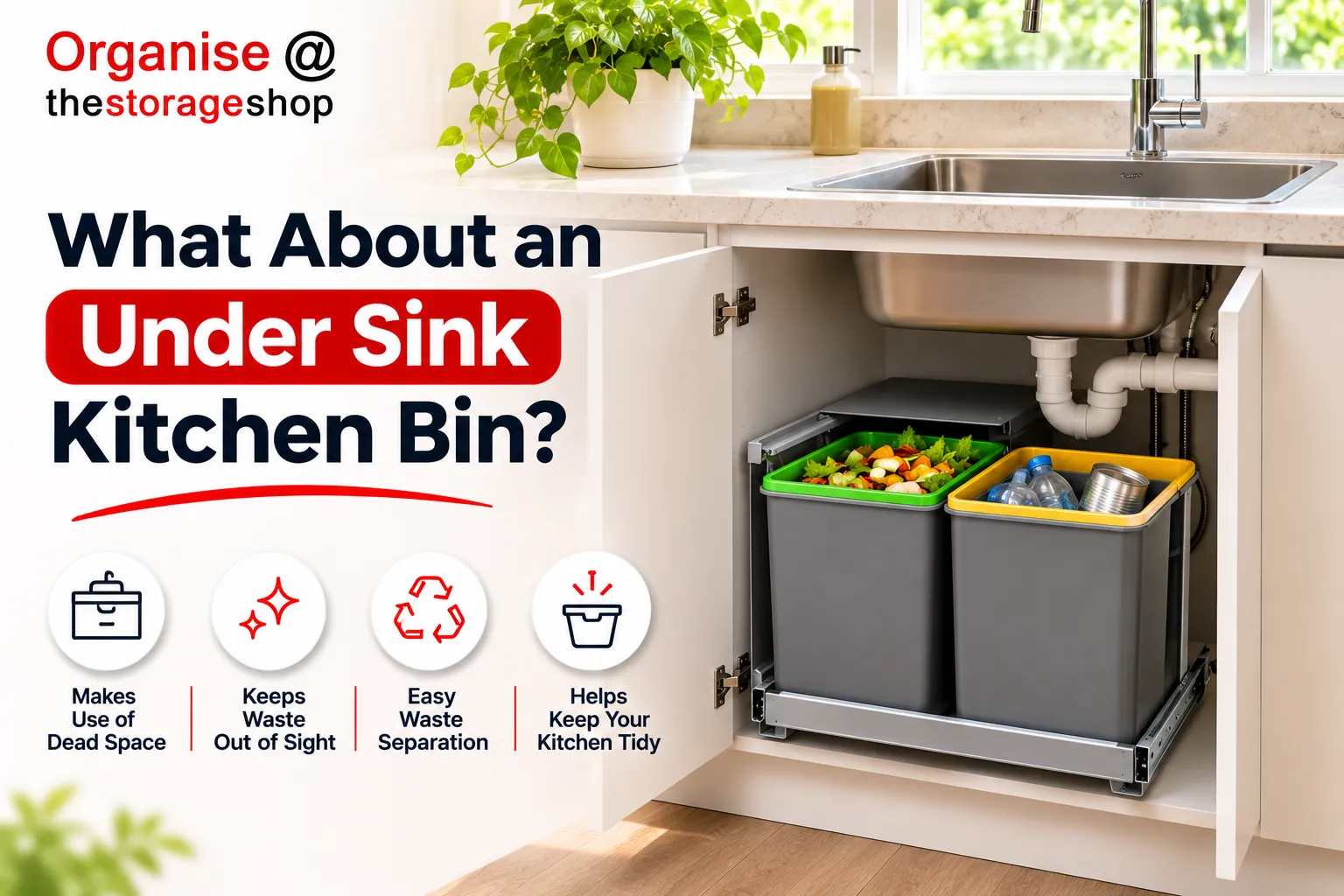
The sink cupboard is the most natural home for a bin, since that’s where peelings and scraps start. It’s also the most awkward space in the kitchen. The waste trap, hoses and taps all take up room.
There are two main options:
-
A low pull out unit that slides out beneath the pipes. It suits wider sink cupboards with good clearance.
-
A swing-out bin of about 5 to 20 litres that’s attached to the door and comes out as you open it. It’s ideal for food scraps.
Before you buy an under sink kitchen bin, measure the clear height from the cupboard floor to the bottom of the trap, plus the gap between the pipes. Sink cupboards also run damp, so check the tap connections for drips now and then.
Costs beyond the price tag
A pull out system costs more on day one, but think about the long run. A cheap freestanding bin often cracks, stains or loses its lid within a few years and gets replaced. A decent pull out frame on good runners lasts as long as the cabinet does, and when a bucket wears out you can usually buy a replacement bucket or lid on its own instead of a whole new unit.
Fitting is another cost to weigh up. A confident DIYer can install most base-mounted units with a drill and a screwdriver. Systems fixed to a drawer-style front need careful alignment, so some homeowners pay a cabinetmaker to do it.
Choosing kitchen rubbish bins: a quick checklist
-
Measure inside the cabinet. Plan widths are external, and the side panels eat into the space.
-
Check bucket sizes, not just the total. A 40-litre double is two 20-litre buckets.
-
Count your waste streams. Rubbish, recycling and food scraps may need three buckets.
-
Choose removable buckets you can rinse outside or in the laundry tub.
Frequently asked questions
Do pull out bins smell more than freestanding bins?
No. A closed cupboard actually keeps smells away from the kitchen. Empty food scraps every day or two and wash the buckets regularly, whichever bin you have.
Can you add a pull out bin to an existing kitchen?
Usually, yes. Base-mounted models screw to the cupboard floor and work behind your existing hinged door, so you don’t need new cabinetry.
Are sensor bins better than pedal bins?
They’re more convenient when your hands are full, but there’s more to go wrong and they need power. A well-made pedal bin is simpler and lasts longer.
The verdict
If you own your home and have a spare base cabinet, Kitchen rubbish bins is the more practical everyday choice, especially once recycling and food scraps come into it. If you rent or want to keep costs down, a good traditional bin with a removable inner bucket is perfectly fine. Measure first, think about who uses the kitchen, and choose the bin that fits how your household actually lives.